Keur Birane: A Story of Collaboration, Progress, and Hope
Project Summary, January 2026
Project Overview
“We've learned to better manage our resources. The well gives us water, the garden feeds us, and the improved cookstoves protect us. I'm proud of what we've built together in the village”, one of the participant in Keur Birane said about your contribution to their life through Bellevue Rotary Club.
We are delighted to share that the partnership between the Keur Birane community, the Bellevue Rotary Club in Washington, USA, and the Rotary Club Dakar Millénium in Senegal successfully completed its second year in December 2025. We truly appreciate the Rotary Clubs for their amazing generosity, vision, and compassion, and we are grateful from the bottom of our hearts. Your support has not only created lasting positive change in Keur Birane but has also sparked hope and a sense of unity that will strengthen for many generations to come.
The site made visible progress in infrastructure, production, and community organizing. Keur Birane maintains 100% operational status of the infrastructure, including well and drip irrigation. The garden is diversified with vegetables such as radish, eggplant, okra, chili, turnip, lettuce, and tomato, yielding abundant, high-quality harvests through organic methods. Poultry units expanded with healthy batches, and arboriculture sustained six fruit species and effective composting cycles. Community-led commissions foster cooperation among community members, maintain high hygiene standards, and provide ongoing training, all of which help make the project more sustainable and encourage active participation.
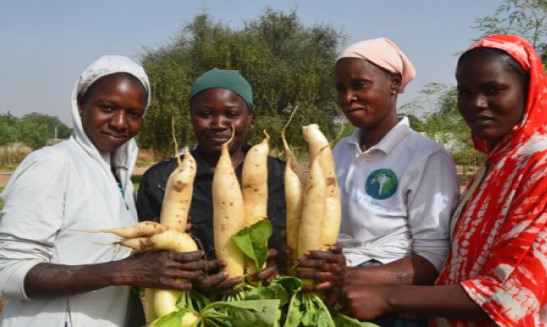
Women in the community have continuous, reliable access to clean water for drinking and agriculture, which has strengthened their productivity and overall well-being. They are engaged in gardening, accessing healthy food, selling vegetables at the market, and generating income from produce sales. Altogether, this site exemplifies resilience and a successful partnership that promotes food security and gender-inclusive economic empowerment.
Water and Energy Infrastructure
Keir Birane is known to be in one of Senegal's remote region, where water inequality is evident due to distances to standpipes, breakdowns, and user costs that limit effective access to water. During periods of low rainfall, there’s less surface water available for drinking and irrigation, so communities often depend more on groundwater. Unfortunately, this resource isn’t always monitored or managed sustainably, creating challenges for everyone involved. And that’s where Keur Biran’s partnership with Rotary comes to fruition: they can now access water effectively for drinking and irrigation.
In Keur Birane, there is one secure, fully protected well that consistently supplies water and one on-site solar pumping system. This well did not need any rehabilitation from September through December. Total water storage capacity on the site (reservoirs and basins) during this time was 29 m³ (cubic meters). The village requires 29,000 liters of water per day. Regarding irrigation, the drip system operated 4 times daily and was well-maintained throughout the months. Six water basins were consistently full during the rainy season. The site also has fencing, storage, toilets, and tools as part of the water site's infrastructure.
Gardening Progress in Keur Birane
September, the first month of fall in Keur Birane, is still a hot month, with temperatures in the range of an average high of 33.6°C (92.5°F) and an average low of 24°C (75.2°F). The rainy season typically lasts from June to October and is called hivernage ("wintering'). In these months, temperatures decrease while moisture increases, creating favorable conditions for the community to grow more vegetables.
Taking advantage of favorable weather conditions, Keur Birane, with support from Rotary, achieved significant vegetable production. This quarter marks the launch of the 2025/2026 agricultural campaign. In this context, the agroecology technician and Keur Birane’s beneficiary partners collaborated to ensure the effective preparation and execution of agricultural activities.
From mid-October to November 2025, the team secured certified seeds, prepared garden beds with organic compost, and established nurseries for lettuce, pepper, tomato, and onion, as well as direct-sown turnips. As October marked the end of the rainy season, the group collectively gathered vegetables and sold them at favorable prices, while chili harvests continued successfully with benefits shared fairly and significant revenues generated at the market. Meanwhile, the prepared turnip bed was maintained in accordance with technical standards, and the okra and eggplant plots were consistently weeded and mulched. By December 2025, the crops showed healthy growth, and the tomato and lettuce plants were successfully transplanted in the evening to minimize stress and maximize recovery. A portion of the harvest was shared among beneficiaries to strengthen solidarity and food security. The remainder were sold at local weekly markets at competitive prices.
The site utilizes a participatory governance model where an "Agroecology Ambassador" oversees specialized commissions—covering harvesting, marketing, plant protection, site works, poultry, and equipment maintenance—to ensure sustainable operations and local autonomy.
As mentioned, vegetable production at the Keur Birane site increased significantly over four months, resulting in total output valued at 120,750 CFA (approximately $200 USD). Some of the wonderful successes we've celebrated include turning turnips from 6.6 lbs to 282 lbs. The community produced chilies reached an exciting 33 lbs at $1.65 per pound, and three lettuce beds were sold for $27 each. These achievements play a meaningful role in supporting the community's food security goals.
Arboriculture and Composting
Keur Birane consistently maintained a variety of trees, including banana, papaya, soursop, lemon, moringa, cashew, and jujube, with a rigorous focus on biodiversity and resilience. The community generously planted 287 food trees like jujube, papaya, cashew, lemon, and banana, along with 413 shade trees each month. This brings the total to an impressive 700 trees across various locations, homes, and schools, with jujube particularly flourishing at an exceptional 149% germination. In Month 3, the papaya produced a nice 44 lbs, valued at $55 USD at $1.24 per pound, while the other trees remained in the nursery or just began their growth with no harvest to report yet.
To boost this production, community compost was applied to the papaya trees every 4 days, leading to promising yields by October. This was supported by a dedicated composting site built in September using plant and animal waste mixed with ash, an integration of residues that reinforces soil fertility and has been extremely beneficial for the land.
Beyond the fields, improved cookstoves reduced firewood use, smoke exposure, and cooking time—resulting in 100% beneficiary satisfaction by September and by the end of the year, the community had already begun planning for next year’s nurseries.
Poultry Production
Poultry batches were raised with 0% reported disease or stress, timed for Tamkharit (celebrates the Islamic New Year), Grand Magal (commemorates Cheikh Ahmadou Bamba's 1895 exile to Gabon), Grand Gamou (honors the Prophet Muhammad's birth/death), and Christmas markets at premium prices. In November, they introduced 200 new chicks, which were supported by 16 feed bags and prophylactics (preventive health treatments) to meet December demand. These 200 chicks were ready for sale by Christmas. December poultry sales generated $1,100 USD from the birds (internal at $5/bird, community at $5.75/bird), 5x the vegetable revenue of $222 USD. The poultry commission coordinated upkeep, sales, and planning.
Overall, Keur Birane is successfully completing its second year and is well-positioned to begin its 3rd year of growth and stability. People in Keur Birane are grateful for the Rotary Club’s support and involvement in their economic and social development and look forward to building a stronger, financially independent community.





 1325 6th Avenue